
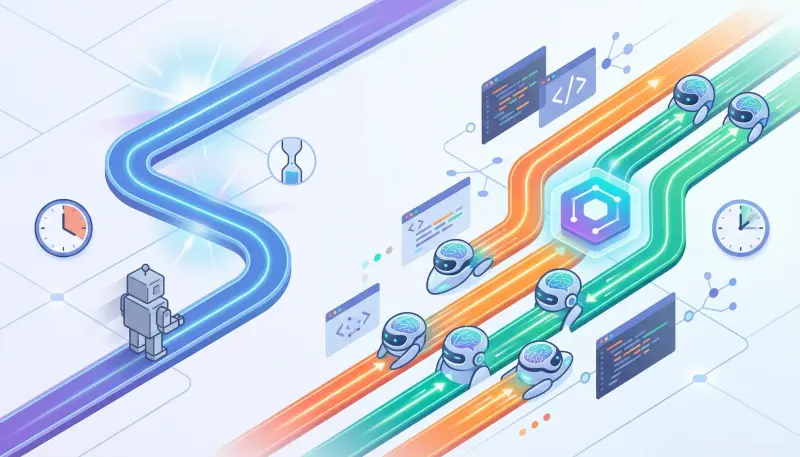
Multi-Agents in Enterprise: A Practical Guide for 2026
Multi-agents in enterprise: architecture, governance, agent sprawl. How AI agents work and what you need to know for 2026. Learn more →

Vít Šafařík
AI & business productivity
2026 is a turning point. The data confirms it.
Gartner predicts that 40% of enterprise applications will have integrated AI agents by the end of this year — last year it was 5%. In the Czech Republic, AI adoption doubled from 5.9% to 11.26% in a single year. 370,000 Czech businesses now use AI in some form.
But most of them are standing on the wrong foundations. They deployed a chatbot, boast about having AI, and then wonder why it doesn’t work in production.
The problem isn’t AI. The problem is what companies think AI agents are.
Chatbot vs. Agent: It’s Not Just Hype
The difference is architectural, not marketing.
Chatbot is a reactive tool:
- waits for a query and responds
- has access to documents via RAG
- can call an API
- doesn’t take initiative — everything starts externally
AI agent is proactive:
- receives a goal, not an instruction
- breaks down the problem into steps on its own
- calls tools and works with results
- iterates and makes decisions
- triggers sequences of actions without external intervention
A Real-World Example
A customer support chatbot answers the question “Where is my order?”. An agent handles the entire workflow — checks the order status, identifies the delay, writes the customer a compensation email, updates the ticketing system, and reports the issue to the logistics team. Without human intervention.
That’s not science fiction. That’s what companies in finance, IT, and automotive — the three industries leading AI adoption in the Czech Republic — are buying today.
Multi-Agent Architecture: A Digital Team, Not a Super-Genius Robot
The biggest mistake I see at companies: they’re looking for one “super-agent” that can handle everything.
That’s like looking for one employee who is simultaneously a senior developer, account manager, and CFO. They don’t exist. And even if they did, it doesn’t scale.
The modern approach is multi-agent systems — digital teams where each agent has:
- a clearly defined role and responsibility
- access only to data it strictly needs
- defined interfaces for communicating with others
Orchestrator and Specialized Agents
A typical architecture works like this:
Orchestrator receives a high-level goal and breaks it down into tasks. It delegates them to specialized agents and collects results. It doesn’t execute — it coordinates.
Specialized agents are focused on a specific domain:
- Data agent — queries databases, cleans inputs, reports anomalies
- Communication agent — writes emails, Slack messages, notifications
- Decision agent — evaluates conditions, escalates exceptions
- Integration agent — calls external APIs, synchronizes systems
This decomposition isn’t just clean architecture — it’s a necessity for auditability, security, and debugging. When something fails, you know exactly where.
Agent Sprawl: The Silent Disaster That’s Coming
Now the bad news. Agent sprawl is a real problem, and Czech companies are just starting to run into it.
The scenario looks like this:
The marketing team deploys an agent for content creation. The sales team creates an agent for CRM updates. HR writes an agent for CV screening. Each team plays in their own sandbox, nobody knows what the others have.
After six months, you have 30 agents in production, of which:
- 8 do duplicate things
- 5 access the same data in different ways
- 3 have access to data they shouldn’t
- nobody knows what exactly the agent deployed by a colleague who quit does
That’s not dystopian fiction. That’s a precise description of what’s happening today in enterprise companies without governance.
How to Prevent Agent Sprawl
You need three things before deploying your first production agent:
1. Agent registry — a central catalog of all agents in the organization. Contains: what they do, who owns them, what permissions they have, when they last passed security review.
2. Least-privilege access — an agent gets access only to what it absolutely needs. Not the entire customer database, just the relevant fields. This is set up at the beginning, not after the first incident.
3. Human-in-the-loop for critical actions — not everything needs to be fully autonomous. Define which actions require human approval: data deletion, communications above a certain volume, financial transactions. This isn’t an admission of defeat — this is responsible design.
Which Tools to Choose
If you don’t have an internal AI engineering team, start with visual tools:
n8n — open-source, self-hostable, visual workflow builder. Increasingly popular in the Czech Republic.
Make.com — (formerly Integromat, a Czech company) excellent for no-code integrations.
Power Automate — a natural choice for companies deep in the Microsoft ecosystem.
For more advanced implementations where you need custom orchestration logic and greater control, you can’t avoid code. Python with frameworks like LangGraph or AutoGen is the current standard in production systems.
How to Choose the Right Tool
The key question isn’t “which tool” but “what do we want to automate and what level of control do we need.”
Before choosing a tool:
- Create a clear process map
- Define where the ROI is greatest
- The platform choice will then follow naturally
If you’re unsure, our services can help with architecture and choosing the right approach.
Czech-Specific Factors You Can’t Ignore
We’re at 18% AI adoption in the enterprise sphere, with the EU average at 20%. Catching up is happening fast, but we have one structural problem.
A shortage of people who know how to deploy it. AI specialists today earn 37% higher salaries than standard IT positions. Demand far outstrips supply.
This has a direct impact on strategy:
- If you’re planning an internal team, realistically account for the costs and longer hiring timelines
- The alternative is an external partner who designs the architecture, trains the team, and then hands over control internally
The good news is that the government supports it. 272 billion CZK is going into digitalization, and one billion CZK is specifically earmarked for process automation. Grant opportunities are real — if you know where to look and how to frame the project.
Three Steps for 2026
Before you start exploring platforms and recruiting AI engineers, do this first:
1. Map your processes — identify the 5 most repetitive workflows that cost your team the most time. That’s where ROI is greatest and a pilot will show results fastest.
2. Start with a small, isolated pilot — one agent, one task, measurable results in 30 days. Not a company-wide transformation all at once.
3. Set up governance from day one — agent registry, access rights, human-in-the-loop for critical actions. This isn’t overhead — this is the foundation everything else stands on.
Want to know where an AI agent makes the most sense in your company and what a realistic architecture looks like for your context? We’ll go through it together as part of an AI audit — no hype, with concrete deliverables. Or get in touch.
Check out our other articles on AI and automation for more inspiration.
Share this article
Found this article helpful? Share it with colleagues who might benefit.