
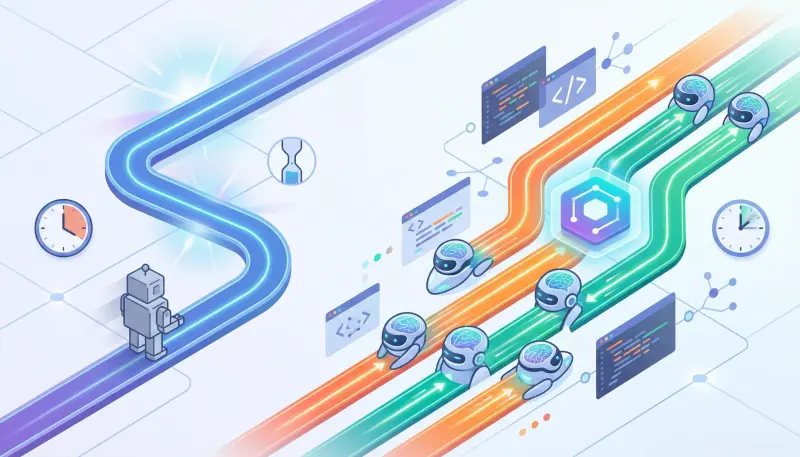
Agent Teams: When One AI Coder Simply Isn't Enough
Claude Code Agent Teams change the game — parallel AI sessions handle in minutes what would take hours sequentially. How does it work in practice?

Vít Šafařík
AI & business productivity
Imagine you need to refactor a million-line codebase. Sequentially — one file after another, one agent after another — that’s days of work. With Claude Code Agent Teams, it’s a matter of hours, maybe minutes.
This isn’t marketing. It’s what’s happening right now, in February 2026, and it’s one of the biggest paradigm shifts in AI-assisted development in the past year.
What are Agent Teams and why it matters
Until now, agentic coding has been linear: one model, one context, one sequence of steps. It worked well for isolated tasks — write a function, fix a bug, review a PR. But real projects aren’t isolated tasks.
Agent Teams transform this model into a distributed one. One Claude Code session functions as a team lead — planning, coordinating, distributing work. Other sessions work independently, each on its own problem segment.
At the end, results are automatically coordinated and merged.
The result: what would take hours of sequential work, Agent Teams complete in minutes of parallel execution.
What it looks like in practice
Concrete example: a large Go project with JetBrains Junie and Claude Code. Instead of the agent going through files sequentially, the team lead distributes the work:
- Agent A: refactors the authentication package
- Agent B: updates API handlers
- Agent C: modifies the test suite
- Agent D: handles dependency updates
Each agent has its own context, its own scope. The team lead monitors consistency and merges outputs. The result arrives in parallel, not sequentially.
For a team of three developers, this means they handle in one afternoon what would traditionally take a full week.
Why now
Agent Teams aren’t the first attempt at parallel AI coding. What changed is that it actually works without constant human babysitting.
Key enablers:
Claude Opus 4.6 as the engine
The new flagship model brings two critical numbers:
- 1M token context window (beta) — each agent sees the entire relevant project context
- SWE-bench score 74.4% — highest in class, 6 percentage points above nearest competition
This isn’t benchmark fluff. SWE-bench is a real test on GitHub issues, where the model must find and fix a bug in production code. 74.4% means Opus 4.6 solves three out of four real bugs autonomously.
MCP integration reduces context overhead
Model Context Protocol now automatically searches for relevant tools instead of loading them all at once. Result: 85% reduction in context usage when working with external integrations (Jira, Slack, Google Drive, custom tools).
For long-running Agent Teams sessions, this isn’t a detail — it’s the difference between whether a session survives the entire task or requires a reset midway.
IDE as first-class citizen
Agent Teams aren’t just a CLI feature. JetBrains integration provides visual overview of what each agent is doing. Xcode 26.3 has direct support for agentic coding right in the editor.
This is an important signal: this isn’t a side tool. It’s becoming part of the standard dev workflow.
Where Agent Teams make sense (and where they don’t)
I’ll be direct: Agent Teams aren’t a silver bullet. They’re extremely powerful in specific scenarios, but have their limits.
Ideal use cases
Large refactorings with clearly defined boundaries — API changes, migration to a new library, framework version upgrade. If the work can be divided into logically separate chunks, Agent Teams parallelize it efficiently.
Boilerplate generation in consistent architecture — CRUD endpoints, test suites, documentation. Each agent generates its segment, team lead ensures consistency.
Multi-service projects — microservices are naturally parallelizable. Each agent works on its service, team lead handles cross-service interfaces.
Security audit + fix cycles — new Claude Code Security feature (available to Enterprise and Team customers) scans codebase with human-like reasoning, not just rule-based matching. Combined with Agent Teams: one agent scans, others fix found vulnerabilities in parallel.
Where it doesn’t work well
Highly coupled code without clear boundaries — if every change potentially affects everything else, parallelization causes conflicts and merging is a nightmare.
Exploratory coding — when you don’t know what you want to build, you need one coherent thought process, not a distributed team.
Small, quick tasks — Agent Teams coordination overhead doesn’t pay off on 30-minute tasks.
Economics of parallel AI development
Here’s the uncomfortable question no one wants to ask loudly: what does this mean for developer headcount?
In the short term, Agent Teams increase productivity of existing teams, not replace people. A senior developer who understands the architecture needs fewer juniors for implementation. A team lead (human) directs Agent Teams instead of directing people.
In the medium term though, it’ll be interesting to watch how staffing practices change in tech companies. If one senior with Agent Teams handles the output of a three-person team, staffing questions will inevitably come up.
For small teams and freelancers, it’s more of an opportunity — suddenly they can compete with larger companies in delivery speed.
What to do right now
If you don’t have Claude Code in your daily workflow yet, this is the moment to start addressing it.
- Audit your workflow — identify tasks where sequential work is slowing you down. Refactoring? Test generation? Dependency updates?
- Set up MCP integrations — Google Drive, Jira, Slack. The more context agents have available, the better they coordinate.
- Start small — parallelize one well-defined project. Understand where the boundaries are and how merging works before deploying it on critical production code.
- Use Analytics API — new enterprise feature tracks usage patterns, costs, and productivity metrics. Without data, you don’t know where Agent Teams add value and where they just add overhead.
If you want to discuss how Agent Teams fit into your specific project architecture, reach out for a consultation. Or if you want to systematically map where AI can accelerate your entire development workflow, check out AI audit.
Bottom line
Agent Teams is the first thing in the AI coding space that changes the fundamental economics of software development — not just speed, but the model itself of how work is distributed.
It’s not for every project. But for the right cases — large refactorings, naturally structured parallel projects, security audits — it’s a leap forward.
With Opus 4.6 at 74.4% SWE-bench, 1M context window, and 85% savings through MCP, the technical foundations are finally where they need to be for reliable production use.
The rest is up to you.
Share this article
Found this article helpful? Share it with colleagues who might benefit.